Wellness
Long-Haul Travel Recovery: How Massage Helps You Readjust
By Zen Massage · 15 Jun 2026
Whether you have flown in for a few days of meetings or a longer assignment, arriving in Bangkok after a long flight is its own particular experience. You step off the plane into warm, humid air, possibly nine or twelve hours — or more — after you boarded, and your body has no clear idea what time it thinks it is. Your legs feel heavy. Your neck is stiff from the headrest. Your ankles may have swollen a little, and you are running on a sleep deficit that the in-flight entertainment did nothing to resolve.
A massage will not undo everything that a long-haul flight does to the body. But it can address several of the most persistent physical effects — and it can do so within the first day or two of arrival, when the difference feels most meaningful.
What long-haul travel actually does to the body
Spending eight or more hours in a pressurised cabin, sitting in a narrow seat with limited room to move, affects the body in ways that go beyond simple tiredness.
- Circulation slows — sitting still for long periods reduces blood flow through the lower limbs. Fluid pools in the legs and feet, which is why ankles swell and calves feel dense and uncomfortable after landing.
- Muscles shorten and stiffen — the seated position shortens the hip flexors, compresses the lower back, and loads the neck and upper shoulders unevenly, particularly if you spent time looking at a screen or trying to sleep at an awkward angle.
- The nervous system stays alert — cabin noise, disrupted sleep, and the mild physiological stress of pressurisation keep the body in a low-level state of alertness that makes genuine rest difficult even after landing.
- Circadian rhythm is disrupted — crossing multiple time zones shifts the body's internal clock away from the local day, leading to the familiar fog of jet lag: difficulty sleeping at night, drowsiness during the day, and a general feeling of being slightly out of step with the world.
How massage addresses these effects
Massage works through several mechanisms that happen to be well matched to the aftermath of a long flight.
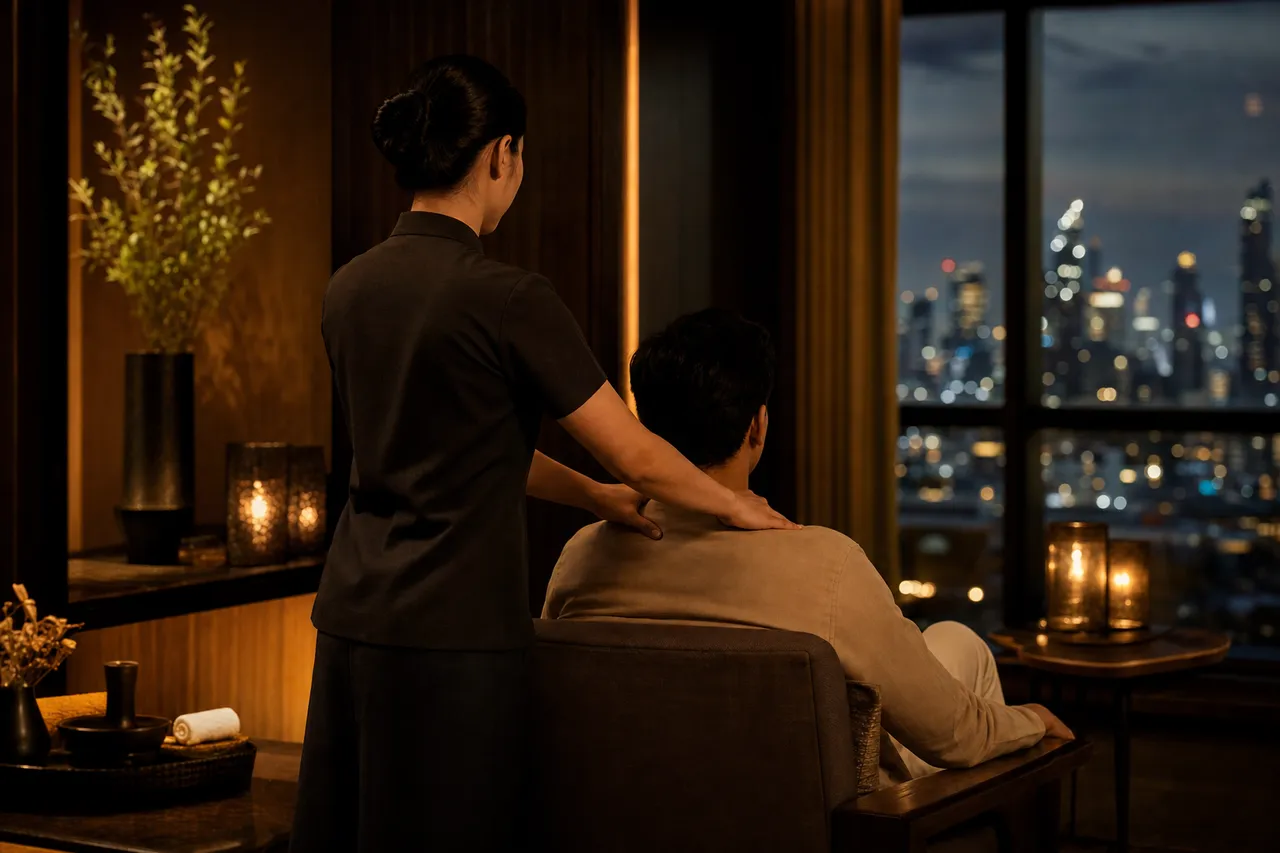
Manual pressure and rhythmic strokes encourage blood and lymphatic fluid to move through the legs and lower body. This can reduce that characteristic post-flight heaviness in the calves and feet more quickly than simply resting would. It is not dramatic — you will not leave feeling like a different person — but the relief is real and tends to carry through the following day.
The muscle work addresses the patterns that sitting creates: tight hip flexors, a compressed lower back, shoulders that have crept forward and upward over many hours. A session that includes some time on the legs, lower back, and upper body can loosen these areas progressively and restore a more natural range of movement.
Perhaps less obvious is the effect on the nervous system. A good massage prompts the body to shift away from that state of low-level alertness and into something closer to rest. Heart rate slows. Breathing deepens. The kind of background tension that accumulates over a long journey — and that you may not have noticed until it begins to ease — softens. For many travellers, this is when the real exhaustion becomes apparent, which is useful information: it means the body is ready to sleep.
Book a session in the early evening of your first full day. This gives you time to rest and shower after landing, and means the relaxed, slightly sleepy feeling after a massage coincides with local nighttime — which helps anchor your sleep to the new time zone. If you would rather not go anywhere, we can come to your hotel: our therapists reach most central Bangkok addresses within 20 to 30 minutes, so you can go straight from the table to bed.
How to approach your first session after a long flight
Arrive hydrated
Flights are dehydrating — recirculated cabin air, alcohol, and coffee all contribute. Drink water in the hours before your session and keep a bottle with you. Well-hydrated muscles respond more readily to massage work, and staying hydrated supports the lymphatic movement the session is intended to encourage. Avoid alcohol in the few hours beforehand.
Tell your therapist what you need
Mention that you have just arrived from a long-haul flight and describe what feels worst. Is it the legs and feet, the lower back, the neck and shoulders, or a general sense of tension and fatigue? A good therapist will adjust both the focus and the pressure accordingly. Post-travel bodies often benefit from slower, more patient work rather than deep or vigorous pressure straight away.
Choose the right treatment length
A 60-minute session allows enough time to cover the main areas affected by long-haul travel — legs and feet, lower back, upper back, neck and shoulders — without rushing. A 90-minute session gives the therapist room to work more slowly and include the arms and scalp, which many people find particularly settling after a tiring journey. A 30-minute session is a reasonable choice if you are very tired and just want focused work on the area that feels worst.
Allow time to rest afterwards
Resist the urge to head straight back out into the city after your session. Give yourself 20–30 minutes to sit quietly, drink some water, and let the effects settle. If you feel sleepy, that is a good sign — try to sleep when it is appropriate to do so locally, even if your internal clock is still running on the time zone you left behind.
What to expect in the days that follow
A single session will not fully resolve jet lag — that is determined by light exposure, sleep timing, and time. But many travellers find that a well-timed massage shortens the adjustment period noticeably, particularly the physical aspects: the leaden legs, the stiff back, the neck that does not quite want to turn.
Some people find they sleep unusually deeply on the night after a session, which helps recalibrate the sleep cycle more quickly. Others notice that the general background noise of fatigue is quieter, which makes it easier to settle into the rhythm of the new location.
If you are in Bangkok for more than a few days, a second session two or three days after the first can be useful for addressing anything that remains, and for working on the subtler patterns — such as hip tightness or upper back stiffness — that often only become apparent once the initial fatigue has cleared.
Circadian desynchrony
/ˌsɜː.keɪ.di.ən ˌdiː.sɪŋ.krə.ni/
The misalignment between the body’s internal clock and the local time at the destination, caused by crossing multiple time zones. Common symptoms include insomnia, daytime fatigue, difficulty concentrating, and digestive disruption. The body typically adjusts at a rate of roughly one time zone per day.
Common questions
How soon after landing can I have a massage?
Most people benefit from waiting until they have slept at least briefly and had a chance to shower and rehydrate. Arriving straight from the airport — exhausted and stiff — often feels urgent, but a few hours of rest first means the body is in a better state to receive the work. The first evening after arrival, or the morning of the following day, tends to be a good window.
Which treatment is best for jet lag recovery?
There is no single treatment that is uniquely suited to it. A traditional Thai massage works well for opening up the hip flexors, lower back, and legs through assisted stretching and compression. An oil massage is gentler and more sedating, which suits people whose primary complaint is tension and fatigue rather than stiffness. A combination session — starting with some Thai work on the legs and lower back, finishing with lighter oil work on the back and shoulders — covers both.
Will it help me sleep?
Many people find they sleep more easily and more deeply on the night after a massage. The shift toward parasympathetic activity that massage encourages — slower heart rate, deeper breathing, reduced muscle tension — is closely related to the physiological state needed for sleep. It is not guaranteed, but the combination of reduced physical tension and a session timed to the local evening makes it more likely than not.
I have been sitting for 14 hours and my lower back is very stiff. Is that safe to treat?
Yes, in most cases. Travel-related stiffness from sustained sitting is very common and responds well to massage. Mention it at the start of the session so your therapist can focus there and adjust the pressure appropriately. If you have a specific back condition — a disc issue, for example, or nerve symptoms running down one leg — mention that too, so they can work around it.