Treatments
How to Ease Lower Back Tension After a Long Flight
By Zen Massage · 18 Sept 2026
The neck and shoulders get most of the attention when people talk about flight stiffness. The lower back rarely gets a mention, yet it usually takes the worst of it. Nine, twelve, fourteen hours locked into one seated position, hips barely moving, spine curved into whatever the seat allows — by the time the wheels touch down in Bangkok, the lower back has quietly become the tightest part of the whole body.
Most travellers notice it standing up at baggage claim: a dull ache low in the spine, a reluctance to bend forward, hips that feel locked rather than loose. It fades within a day or two on its own, but it does not have to take that long. A well-aimed massage the evening you land can undo most of it in one session.
Why the lower back takes the hit on long flights
A seated position keeps the hip flexors shortened for hours at a time. When they finally get to lengthen again, they pull on the lower back and can leave it feeling locked rather than simply tired. Add in a mattress-thin seat cushion, minimal circulation from sitting still, and the subtle bracing most people do without noticing during turbulence, and the lumbar region ends up carrying tension that has nowhere else to go.
Quadratus Lumborum
/ˌkwɒdrəˈtiːtəs lʌmˈbɔːrəm/
A deep muscle running from the lower ribs to the pelvis on either side of the spine. It works constantly to keep the torso upright while seated, and it is one of the first places a long flight shows up as stiffness.
Treating it once you land
Don't wait for it to pass on its own
The instinct after a long flight is to shower, eat, and collapse into bed. That is fine, but it often lets the tightness settle in overnight rather than release. Booking a session for the evening you arrive, while the muscles are still warm from movement through the airport and taxi, tends to get better results than waiting until the next day.
Ask for firm work through the hips as well as the back
A session focused only on the spine misses half the picture. Mention the hip flexors and glutes specifically — that is usually where the real source of the tightness is sitting, even if the ache you feel is centred lower in the back.
Choose a treatment built for stretching, not just pressure
Traditional Thai massage works the hips and lower back through assisted stretching and compression rather than pressure alone, which is often exactly what a body needs after being folded into one position for half a day. An oil massage with firm, slow strokes along the lower back is a good alternative if a gentler pace suits you better.
Let the session run the full length
Lower back tension built up over many hours rarely releases in the first twenty minutes. A full session gives a therapist time to work through the hips, glutes, and lower back in sequence rather than rushing straight to the sore spot.
Outcall means you can go straight from arrival to treatment. Booking a therapist to your hotel room removes the extra travel that a studio visit adds on top of an already long day — you can be on the table within the hour of checking in.
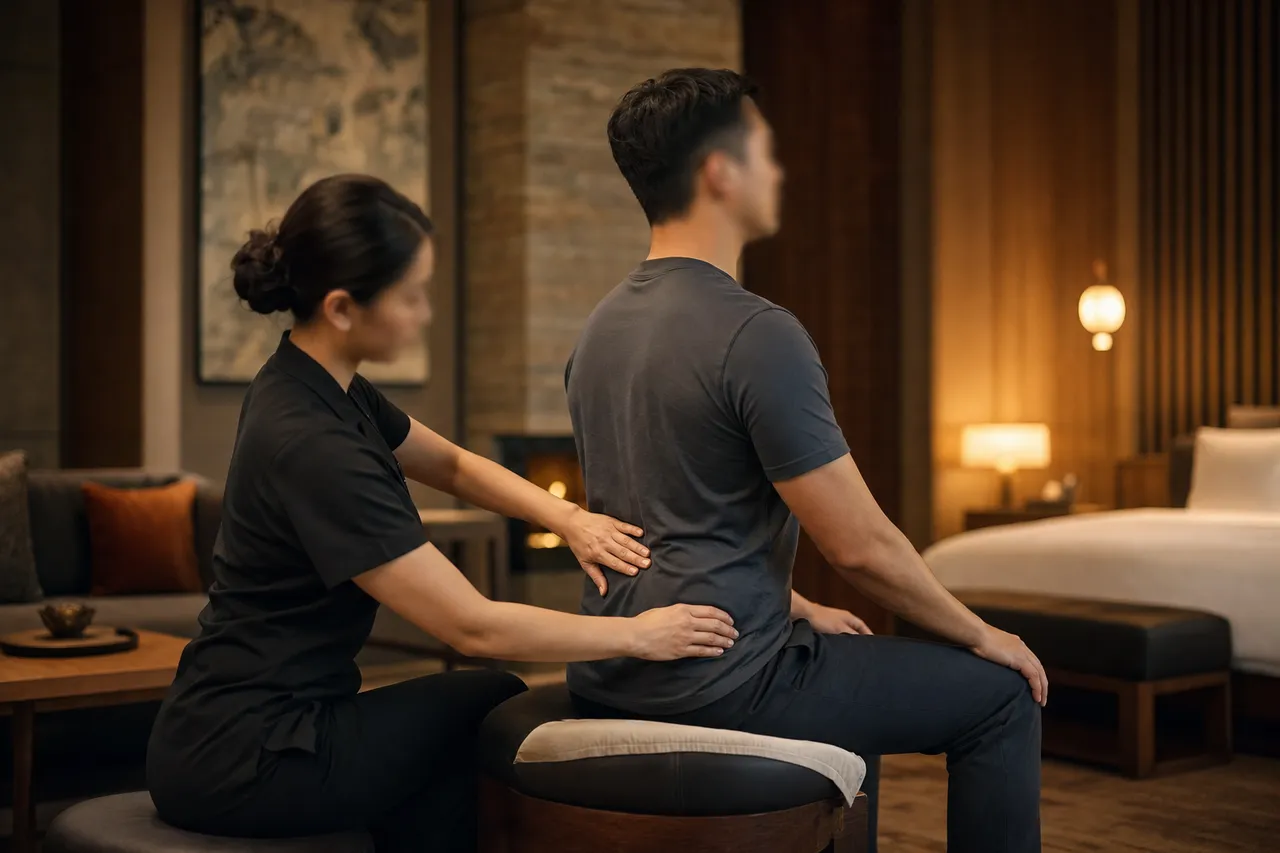
Thai massage or oil massage: which suits the job better
Pros
- Thai massage uses assisted stretching that directly targets tight hip flexors
- Compression work reaches deeper into the glutes than oil strokes alone
- No oil means you can go straight back into travel clothes after
Cons
- Firmer overall pace, which is not for everyone straight off a long flight
- Less suited to a slow, sleep-focused wind-down
If the goal is purely to unwind and drift toward sleep, a gentler oil massage with firm lower-back strokes can still do the job — it simply takes a little longer to reach the same release that a Thai session gets to more directly.
The lower back is honest. It tells a therapist exactly how many hours you just sat still for.
What to expect during the session
A therapist working on post-flight lower back tension will typically start broad — warming up the whole lower back and hip area — before narrowing in on the tightest spots. Expect some work along the sides of the spine, through the glutes, and often into the outer hip, since tension in that area frequently mirrors what is happening in the lower back itself.
Signs a session is targeting the right area
- Attention to the hips and glutes, not just the spine itself
- Slow, sustained pressure rather than quick surface strokes
- A check-in on pressure as the tightest spots are found
- Some stretching or compression if the treatment is Thai-based
- Book for the evening you land, not the day after
- Mention the hips and glutes, not just the lower back
- Choose Thai for stretching, oil for a slower wind-down
- Give the session its full length to work through properly
Common questions
Why does my lower back hurt more after flying than my neck or shoulders?
The lower back absorbs the effect of hours with shortened hip flexors and reduced movement, which often makes it the tightest area on landing even though the neck and shoulders get more attention in general travel advice.
Is Thai massage too intense for lower back pain straight after a flight?
Not typically. A good therapist adjusts pressure and pace to what the body can take on a given day — mention that you have just landed and want firm but comfortable work, and the session will be paced accordingly.
Should I stretch before the massage or just let the therapist do the work?
A short walk or a few gentle stretches beforehand can help, but it is not required. The massage itself, particularly a Thai session, does much of that stretching work for you.
How long does the tightness usually last if I don't get a massage?
It often eases within a day or two on its own as normal movement resumes, but many travellers find it lingers longer than expected if the days that follow are also spent mostly seated in meetings.